UX Design Course: Learn User Experience Design with Practical, AI-Powered Skills
A UX Design Course helps aspiring designers build the practical knowledge required to create useful, accessible, and engaging digital experiences. From understanding user needs to creating wireframes, prototypes, design systems, and conducting usability testing, UX design combines research, creativity, psychology, and technology.
At Weekend UX, the learning experience is designed for students, working professionals, entrepreneurs, and aspiring designers who want to develop job-ready UX skills through practical learning. The course covers essential areas such as UX Research, User Research, Design Thinking, Visual Design, Interaction Design, Usability Testing, Design Systems, Service Design, and Product Design.
With businesses increasingly focused on customer experience and digital products, skilled UX designers are in demand across technology companies, startups, agencies, e-commerce businesses, financial services, healthcare platforms, and other industries. A structured UX Design Course can help learners understand the complete design process and build a professional portfolio.
What Is a UX Design Course?
A UX Design Course is a structured learning program that teaches students how to research users, identify problems, develop design concepts, test solutions, and improve digital experiences. UX stands for User Experience, which focuses on how people interact with products, websites, applications, and services.
Unlike learning only visual design, UX education focuses on the complete user journey. Students learn how to understand user behaviour, define problems, organize information, create interfaces, prototype ideas, and validate designs with real users.
A comprehensive UX Design Course generally includes both theoretical concepts and hands-on projects. Learners work through the UX process from research and problem definition to ideation, wireframing, prototyping, testing, and final design.
At Weekend UX, the curriculum focuses on practical application so learners can understand not just what UX design is, but also how professional designers use UX methodologies to solve real-world problems.
Why Learn UX Design?
Digital products succeed when they solve genuine user problems. UX designers play an important role in making products easier to understand, navigate, and use.
A UX Design Course can help learners develop skills that are valuable across multiple industries. Some of the major benefits include:
Learn the complete UX design process.
Understand user behaviour and customer needs.
Develop strong UX Research and User Research skills.
Learn Design Thinking and problem-solving methodologies.
Create wireframes and interactive prototypes.
Improve Visual Design and interface design skills.
Conduct usability testing.
Build and maintain design systems.
Understand information architecture and user flows.
Create professional UX case studies.
Develop a portfolio for career opportunities.
Learn modern AI-powered design workflows.
UX design also encourages continuous learning. Designers need to understand users, business objectives, technology, accessibility, and changing digital trends.
UX Design Course Curriculum
A well-structured curriculum should cover the complete UX workflow. The Weekend UX program focuses on practical skills that can help learners progress from beginner-level concepts to professional design projects.
1. Introduction to UX Design
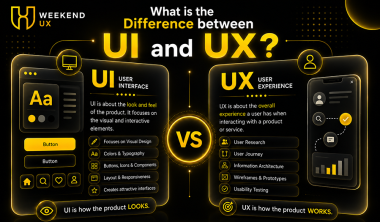
The course begins with the fundamentals of User Experience Design. Students learn about UX principles, the role of a UX designer, design processes, user-centred design, and the difference between UX and UI design.
Understanding these fundamentals gives learners a strong foundation before moving into advanced topics.
2. UX Research
It helps designers understand users, their motivations, behaviours, frustrations, and expectations.
Students learn research methodologies such as:
User interviews
Surveys
Observation
Competitive analysis
User personas
Empathy mapping
User journey analysis
Qualitative research
Quantitative research
Research findings help designers make informed decisions rather than relying only on assumptions.
3. User Research
User Research focuses on collecting and analysing information about target users. Students learn how to identify research objectives, prepare interview questions, conduct research sessions, analyse findings, and translate insights into actionable design opportunities.
Effective User Research helps organizations create products that address genuine customer problems.
4. Design Thinking
Design Thinking provides a structured approach to solving complex problems. Learners explore stages such as empathizing with users, defining problems, generating ideas, creating prototypes, and testing solutions.
The methodology encourages experimentation and helps designers approach problems from the user's perspective.
5. Information Architecture
Information Architecture focuses on organizing content and functionality so users can easily find what they need.
Students learn about:
Content organization
Navigation systems
Categorization
Site maps
User flows
Hierarchy
Search structures
Good information architecture can make websites and applications easier to navigate.
6. Wireframing
Wireframes provide a structural representation of a digital product before detailed visual design begins.
A UX Design Course teaches learners how to create low-fidelity and high-fidelity wireframes for websites, mobile applications, and digital products. Students learn how to focus on layout, hierarchy, functionality, and user flow before spending significant effort on visual details.
7. Prototyping
Prototyping allows designers to transform ideas into interactive experiences. Students learn how to create clickable prototypes that simulate user interactions.
Prototypes are useful for communicating design concepts to stakeholders and identifying usability issues before development.
8. Visual Design
Visual Design focuses on the appearance and presentation of digital interfaces. Learners explore principles including typography, spacing, grids, hierarchy, composition, imagery, color, and consistency.
Strong Visual Design supports usability by making information easier to understand and interactions easier to recognize.
9. Interaction Design
Students learn about buttons, navigation, forms, feedback, transitions, micro-interactions, and interaction patterns.
The objective is to make digital products predictable, efficient, and enjoyable to use.
10. Usability Testing
Usability Testing helps designers evaluate whether users can successfully complete tasks within a product.
Students learn how to:
Define testing objectives
Prepare usability tasks
Recruit participants
Conduct testing sessions
Observe user behaviour
Identify usability problems
Analyse findings
Recommend improvements
Testing helps transform assumptions into evidence-based design decisions.
11. Design Systems
Design Systems provide reusable components, patterns, rules, and guidelines for creating consistent digital products.
Learners explore components, typography, color systems, spacing, buttons, forms, cards, navigation, and documentation.
Understanding Design Systems is especially valuable for designers working on large products and collaborative teams.
12. Service Design
Service Design expands UX thinking beyond individual screens. It examines the complete experience customers have with a service.
Students may explore customer journeys, service blueprints, touchpoints, frontstage and backstage processes, and opportunities for service improvement.
13. AI-Powered UX Design
Modern UX workflows increasingly include artificial intelligence. An updated UX Design Course can introduce learners to AI-assisted research, ideation, content generation, design exploration, usability analysis, and workflow automation.
AI should support the designer rather than replace human understanding. Designers still need research, critical thinking, empathy, creativity, and validation skills to make responsible decisions.
Tools You Can Learn
A practical UX learning program should introduce learners to industry-relevant tools and workflows. Depending on the curriculum, students may work with tools for:
UI design
Wireframing
Prototyping
User research
Collaboration
Design systems
Presentation
AI-assisted design
Learning tools is useful, but understanding UX principles is more important than memorizing software features. Tools change frequently, while fundamental design thinking and research skills remain valuable.
Who Should Join a UX Design Course?
A UX Design Course can be suitable for a wide range of learners, including:
Students
Students from design, technology, management, communication, or other backgrounds can explore UX as a career path.
Working Professionals
Professionals can use UX skills to transition into design roles or add user-centred thinking to their existing responsibilities.
Graphic Designers
Graphic designers can expand their visual expertise into research, interaction design, usability, and product thinking.
UI Designers
UI designers can strengthen their understanding of user behaviour, research, information architecture, and usability.
Entrepreneurs
Founders can learn how to identify customer problems and validate product concepts before investing heavily in development.
Career Switchers
People moving into the design industry can use structured learning and portfolio projects to demonstrate their capabilities.
Career Opportunities After a UX Design Course
Completing a UX Design Course can prepare learners for several design-related career paths. Depending on their skills and experience, learners may explore roles such as:
UX Designer
UI/UX Designer
Product Designer
UX Researcher
Interaction Designer
Visual Designer
Service Designer
Information Architect
Design System Designer
Usability Specialist
Career progression depends on practical skills, portfolio quality, communication ability, industry knowledge, and professional experience.
Build a UX Portfolio
A portfolio is one of the most important assets for an aspiring UX designer. Employers and clients want to understand how a designer approaches problems, not just see polished interfaces.
During a UX Design Course, learners should create detailed case studies that demonstrate:
The problem
Target users
Research process
Key insights
User personas
User journey
Problem definition
Ideation
Wireframes
Prototypes
Usability testing
Design iterations
Final solution
Results and learnings
A strong case study explains the reasoning behind design decisions and demonstrates the ability to solve problems systematically.
Why Choose Weekend UX?
Weekend UX focuses on helping learners develop practical design capabilities through structured learning. The approach combines UX fundamentals with contemporary design practices and AI-powered workflows.
The program can be particularly useful for learners who want flexible learning alongside college, employment, or other commitments.
The goal is to help students understand the complete design process rather than focusing exclusively on software or visual styling. Through research, ideation, prototyping, testing, and portfolio development, learners can build a stronger foundation for entering the UX industry.
How to Choose the Right UX Design Course
Before enrolling in a UX Design Course, consider the following factors:
Curriculum: Check whether the program covers research, interaction design, visual design, prototyping, testing, and portfolio development.
Practical Projects: Look for opportunities to solve realistic design problems rather than only watching theoretical lessons.
Portfolio Support: A good course should help learners create case studies that demonstrate their design process.
Industry Relevance: Check whether the curriculum reflects current UX practices, design systems, accessibility, product thinking, and AI-assisted workflows.
Learning Format: Consider whether the schedule and delivery format fit your professional or academic commitments.
Mentorship: Feedback from experienced designers can help learners identify weaknesses and improve their work.
Start Your UX Design Journey
UX design combines research, creativity, technology, psychology, and problem-solving. A structured UX Design Course can help learners understand how these disciplines work together to create meaningful digital experiences.
From UX Research and Design Thinking to wireframing, prototyping, Visual Design, Usability Testing, and Design Systems, learners can develop a broad skill set that supports modern product development.
With Weekend UX, aspiring designers can focus on practical learning, real-world projects, portfolio development, and AI-powered design workflows. Whether you are a student, working professional, designer, entrepreneur, or career switcher, developing UX skills can open opportunities to work on digital products and customer experiences.
If your goal is to build a career in UX, the right learning path should go beyond tools. Focus on understanding users, solving meaningful problems, communicating design decisions, testing ideas, and continuously improving your work.
Conclusion
Choosing the right UX Design Course can provide a structured pathway for developing user-centred design skills. A strong program should combine UX Research, User Research, Design Thinking, information architecture, wireframing, prototyping, Visual Design, Interaction Design, Usability Testing, Design Systems, and Service Design.
At Weekend UX, learners can build practical knowledge while working toward portfolio-ready projects and understanding modern AI-powered design workflows. By consistently practicing research, problem-solving, prototyping, testing, and communication, aspiring designers can create a strong foundation for a career in UX and digital product design.