Service Design Course: Build Future-Ready Skills with Weekend UX
A Service Design Course helps professionals learn how to understand customer needs, identify service problems, map user journeys, and design seamless experiences across digital and physical touchpoints. As businesses increasingly compete through customer experience, service design has become an important skill for UX designers, product designers, business strategists, marketers, and entrepreneurs.
At Weekend UX, the Service Design Course is designed to provide practical, industry-focused learning through real-world projects, research methods, customer journey mapping, service blueprinting, prototyping, and experience strategy. The curriculum helps learners understand how services work from both the customer and business perspective.
Whether you are starting your UX career, upgrading your existing design skills, or moving toward strategic design roles, this course can help you develop a structured approach to solving complex service challenges.
What Is Service Design?
Service design is a human-centered approach to improving services by understanding customer expectations, business requirements, employee needs, and operational processes. Instead of focusing on a single product or interface, service design considers the complete experience.
A well-designed service connects multiple touchpoints, including websites, mobile applications, physical locations, customer support, communication channels, employees, and backend systems.
The Service Design Course teaches learners to analyze these interconnected experiences and identify opportunities for meaningful improvement.
For example, a banking service is not only its mobile application. The complete experience may include account opening, identity verification, branch visits, customer support, notifications, payment processes, and complaint resolution. Service designers examine the entire ecosystem to make the experience more useful, efficient, and consistent.
Why Learn Service Design?
Organizations across industries are investing in customer experience and digital transformation. This creates demand for professionals who can connect customer expectations with business and operational requirements.
A Service Design Course can help you develop skills in:
Customer experience design
User research
Customer journey mapping
Service blueprinting
Design thinking
Experience strategy
Stakeholder mapping
Prototyping
Systems thinking
Problem definition
Workshop facilitation
Business and service innovation
These skills are useful for designers and professionals working in technology, banking, healthcare, retail, education, hospitality, SaaS, consulting, and other customer-facing industries.
Service Design Course at Weekend UX
The Weekend UX Service Design Course focuses on practical learning rather than theory alone. Learners can explore how research insights become actionable service improvements through structured design processes.
The course is particularly useful for people who want to understand how UX extends beyond screens. While UX design often focuses on interfaces and interactions, service design considers the broader ecosystem surrounding a customer experience.
At Weekend UX, learners can develop a stronger understanding of how different teams, channels, systems, and touchpoints work together to deliver a service.
What Will You Learn?
1. User Research
Research is an essential part of service design. Before designing a solution, designers need to understand the people experiencing the service.
You can learn research approaches such as:
User interviews
Contextual research
Observation
Surveys
Qualitative research
Quantitative research
Stakeholder interviews
Customer feedback analysis
The objective is to uncover customer behaviors, expectations, frustrations, motivations, and unmet needs.
2. Customer Journey Mapping
Customer journey mapping helps visualize the complete experience a customer has while interacting with a service.
A journey map can highlight:
Customer goals
Key touchpoints
Actions
Thoughts
Emotions
Pain points
Opportunities
Service gaps
By understanding the journey from beginning to end, designers can identify moments that need improvement.
3. Customer Experience Design
Customer Experience (CX) design focuses on creating consistent and meaningful experiences across different service touchpoints.
A service may involve several channels, including websites, apps, emails, call centers, physical stores, chat support, and employees. CX design helps ensure that these interactions work together instead of operating as disconnected experiences.
4. Service Blueprint
A service blueprint provides a structured view of how a service operates.
Unlike a customer journey map, which primarily represents the customer's experience, a service blueprint can connect customer-facing interactions with backstage activities and supporting processes.
Typical elements include:
Customer actions
Frontstage interactions
Backstage activities
Support processes
Systems
Employees
Touchpoints
This makes service blueprinting particularly valuable when designing or improving complex services.
5. Stakeholder Mapping
Services usually involve multiple stakeholders. Customers are only one part of the ecosystem.
Stakeholders can include:
Customers
Employees
Managers
Business owners
Technology teams
Operations teams
Partners
Vendors
Stakeholder mapping helps designers understand relationships, responsibilities, expectations, and potential conflicts.
6. Design Thinking
Design thinking provides a human-centered framework for solving complex problems.
Within a Service Design Course, design thinking can help learners move from customer problems to practical service concepts.
7. Systems Thinking
Services are interconnected systems. Changing one part of an experience can affect another.
Systems thinking helps designers examine relationships between people, processes, technology, policies, organizations, and environments.
This perspective is especially valuable for complex services where a simple interface improvement cannot solve the underlying problem.
Service Design Course Curriculum
A practical curriculum may cover the following areas:
Module 1: Introduction to Service Design
Service design fundamentals
Human-centered design
Service ecosystems
Design principles
Product vs UX vs service design
Real-world service examples
Module 2: Research & Discovery
Research planning
User interviews
Stakeholder interviews
Observation
Research synthesis
Affinity mapping
Identifying patterns and insights
Module 3: Customer Journey Mapping
Journey mapping fundamentals
Customer stages
Touchpoints
Pain points
Emotional journey
Moments of truth
Opportunity identification
Module 4: Service Blueprinting
Blueprint fundamentals
Frontstage and backstage
Support processes
Employee interactions
Operational dependencies
Identifying service gaps
Module 5: Experience Strategy
Experience principles
Opportunity areas
Service concepts
Business objectives
Customer needs
Prioritization frameworks
Module 6: Ideation & Prototyping
Brainstorming
Concept development
Storyboarding
Service prototyping
Scenario creation
Testing service concepts
Module 7: Implementation
Stakeholder communication
Design recommendations
Measuring service improvements
Service KPIs
Continuous improvement
Presenting service design solutions
Who Should Join a Service Design Course?
A Service Design Course can be suitable for:
UX Designers
UX designers who want to move beyond interface design can learn how customer experiences connect across multiple touchpoints.
Product Designers
Product designers can use service design methods to understand how their products fit within larger customer journeys.
UX Researchers
Researchers can expand their capabilities by connecting research insights with service ecosystems and business processes.
Product Managers
Product managers can use service design frameworks to identify customer problems, align stakeholders, and improve end-to-end experiences.
Business Professionals
Business professionals can learn how customer-centric design approaches can support innovation and service improvement.
Entrepreneurs
Entrepreneurs can use service design methods to understand customer needs and develop better service experiences.
Freshers and Students
Students interested in UX, product design, customer experience, and innovation can use service design as a foundation for developing strategic design skills.
Career Opportunities After a Service Design Course
Learning service design can support career growth across multiple roles.
Potential career paths include:
Service Designer
UX Designer
CX Designer
UX Researcher
Product Designer
Experience Designer
Design Strategist
Innovation Consultant
Product Manager
Customer Experience Strategist
The right career path depends on your previous experience, portfolio, industry knowledge, and ability to demonstrate practical problem-solving skills.
Benefits of Learning Service Design
Think Beyond Interfaces
Service design encourages designers to look beyond screens and understand the complete experience.
Solve Complex Problems
You learn structured methods for investigating complicated customer and business challenges.
Improve Customer Experiences
Journey mapping and service blueprinting help reveal friction and opportunities across the customer lifecycle.
Collaborate With Teams
Service design involves collaboration with business, technology, operations, marketing, and customer-facing teams.
Build Strategic Skills
The discipline connects design with business objectives, making it useful for professionals seeking more strategic responsibilities.
Why Choose Weekend UX?
Weekend UX focuses on helping learners develop practical UX and design capabilities that can be applied to real-world projects.
The Service Design Course can help learners build an understanding of research, journey mapping, service blueprinting, experience strategy, and systems thinking.
A project-oriented learning approach can also help students transform theoretical concepts into portfolio-ready case studies.
For professionals, this can provide an opportunity to apply service design frameworks to realistic business problems while developing stronger communication and presentation skills.
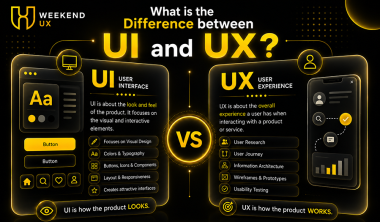
Service Design vs UX Design
UX design primarily focuses on how people interact with a product, service, or interface. Service design takes a broader perspective.
For example, a UX designer may improve the checkout experience of an e-commerce application. A service designer may examine the entire shopping experience, including product discovery, checkout, payment, delivery, notifications, returns, customer support, and backend operations.
Both disciplines are closely connected, and UX professionals can benefit significantly from learning service design.
Service Design vs Product Design
Product design generally focuses on creating and improving products, often combining user experience, visual design, interaction design, business requirements, and technology.
Service design considers how a product operates within a broader service ecosystem.
For example, a food delivery application is part of a larger service involving customers, restaurants, delivery partners, payment systems, customer support, logistics, and technology infrastructure.
Service designers examine these relationships to improve the complete experience.
How a Service Design Project Works
A typical project can follow a structured process.
Discover
Start by understanding the problem, business context, customers, and stakeholders.
Research
Collect qualitative and quantitative information to understand user needs and existing experiences.
Define
Synthesize findings and clearly define the most important customer and business problems.
Map
Create customer journey maps, stakeholder maps, and service blueprints to visualize the ecosystem.
Ideate
Generate multiple ideas and identify opportunities for improving the service.
Prototype
Create representations of proposed service experiences to explore and communicate ideas.
Test
Gather feedback from customers, employees, stakeholders, or other relevant users.
Implement
Translate validated opportunities into actionable recommendations and improvements.
Skills You Can Develop
A strong Service Design Course can help learners develop both technical and strategic capabilities.
These include:
Research planning
Interviewing
Data synthesis
Customer journey mapping
Service blueprinting
Experience mapping
Systems thinking
Workshop facilitation
Storytelling
Prototyping
Strategic thinking
Stakeholder management
Presentation skills
These capabilities can strengthen a designer's portfolio and help demonstrate the ability to solve problems beyond visual design.
Build a Service Design Portfolio
A portfolio is an important part of demonstrating your service design capabilities.
A strong case study can include:
Project background
Business challenge
Research objectives
Research methodology
Research findings
Customer personas or segments
Customer journey map
Pain points
Opportunity areas
Service blueprint
Ideation process
Proposed solution
Prototype
Testing
Final recommendations
Expected impact
Instead of simply showing polished visuals, service design portfolios should explain the thinking behind decisions.
Who Can Benefit From Weekend UX?
Weekend UX can be useful for learners at different stages of their careers. Beginners can develop foundational knowledge, while experienced UX and product professionals can expand into strategic and service-oriented design.
The course can also be relevant to professionals looking to understand customer experience, digital transformation, innovation, and human-centered problem solving.
Conclusion
A Service Design Course can help professionals develop the ability to understand customers, identify service problems, visualize complex ecosystems, and create better end-to-end experiences.
From user research and customer journey mapping to service blueprinting, prototyping, and experience strategy, service design provides a structured approach to solving problems that involve people, processes, technology, and business.
With its practical learning focus, Weekend UX can help learners build service design knowledge and apply it to real-world challenges. Whether you are a UX designer, product designer, researcher, product manager, entrepreneur, or aspiring designer, learning service design can expand your perspective and create new opportunities for professional growth.